Pump Selection and Sizing
Choosing the right pump for a new system involves several steps:
Define Requirements: Determine the required flow rate (Q) and total head (H) under design conditions.
Develop the System Curve: Given flow vs. total head known, sketch the system curve.
Pump Type Selection: Based on flow/head and fluid properties: If moderate head and very high flow is needed (e.g., general water services), a centrifugal pump is likely best. If extremely high head or very viscous/slurry fluids are considered, consider a positive-displacement design or a multi-stage pump.
Check fluid properties: viscosity (affects pump performance), temperature (affects vapour pressure), and solids content (may require an open impeller or a special pump).
Check materials: Is the fluid corrosive, abrasive, or high-temperature? That will influence both pump type and construction materials (see below).
Material & Seal Selection: Choose casing/impeller materials compatible with the fluid.
Check NPSH: Ensure the chosen pump can meet the NPSH requirement.
Drive and Control: Pick a motor (or driver) rated for the pump’s required power (plus overhead for starting/inrush).
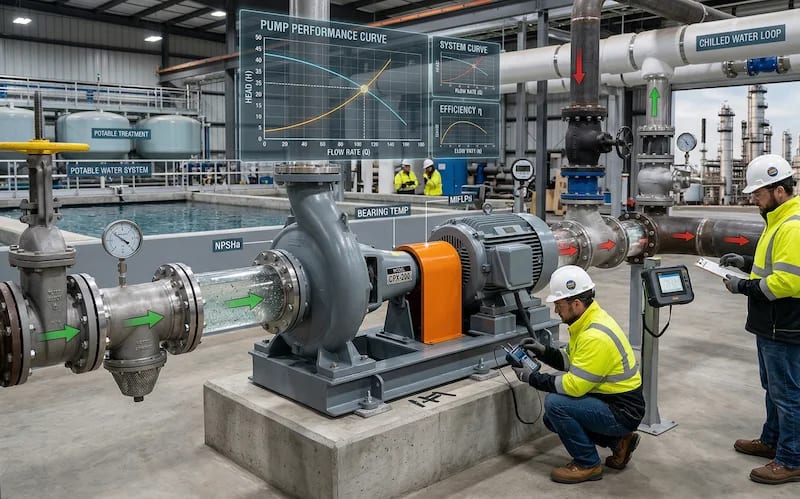
Validate: Once a pump is chosen, verify via the published performance curves that at the required flow, the pump produces at least the required head.
By following this systematic approach (often guided by the manufacturer or consulting engineering), you avoid simply picking a pump by price or guesswork.
Installation, Commissioning & Operation
Proper installation is critical to make a pump perform as designed. Some best practices:
Solid Foundation and Alignment: The pump (and motor) should be mounted on a rigid, level baseplate that’s grouted to the foundation.
Piping Support and Layout: Suction and discharge piping must be independently supported; do not allow pipe weight to rest on the pump flanges.
Valves and Instrumentation: Install a suction isolating valve, discharge valve, and a purge (drain) valve for maintenance.
Startup: Before starting, prime the pump by filling the casing with fluid (unless it’s self-priming).
Operating Range (BEP): Pumps run most stably at or near their BEP.
Shutdown: Close valves properly and allow the pump to slow before stopping; a soft-stop, if available, is even better.
In short, installation and operation must respect the pump’s requirements.
Maintenance & Reliability
Even the best pump will fail prematurely without good maintenance. Here are key reliability tips:
Inspection & Monitoring: Regularly check vibration levels, bearing temperatures, and outlet pressure/flow.
Lubrication: Follow the manufacturer’s schedule for greasing or oil changes.
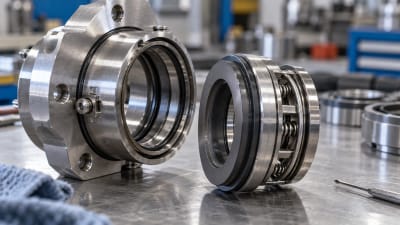
Seal/Pack Maintenance: Mechanical seals wear over time; replace them at the first sign of weeping.
Alignment Checks: Even after initial alignment, parts can shift (thermal growth, foundation settling, etc.).
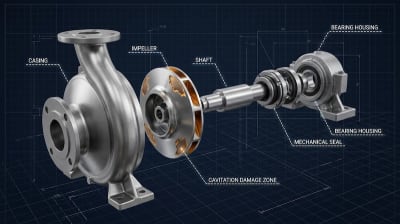
Impeller and Wear Parts: Periodically inspect impellers, wear rings, and casings for erosion or clogging.
Common Failures: From industry experience, typical causes include cavitation damage, bearing failure (from misalignment or overspeed), seal leaks, and pipe clogging.
Troubleshooting Guide: In a recent survey of pump problems, reduced flow was often due to inlet clogging or impeller wear, abnormal noise was usually misalignment or bearing, and vibration often pointed to imbalance or cavitation.
Preventive Maintenance Schedule: Keep a log of maintenance tasks: e.g. weekly visual checks, monthly vibration readings, annual teardown and bearing replacement, etc.
Industrial Applications
Pumps serve in every sector. Here are some common uses:
Water Supply & Irrigation: Centrifugal pumps dominate for high-flow, low-head applications such as municipal water distribution, irrigation pumping, and flood control.
Wastewater & Sewage: Here you see both types.
Oil & Gas / Petrochemical: API 610 pumps (between-bearings, horizontally-split) are standard in refineries and gas plants.
Chemical / Process Industries: Chemical pumps (often high-quality stainless or alloy) meter acids, bases, solvents, and process streams.
Power Plants: Boiler feedwater pumps (often boiler-fed with condensate) are typically large, multi-stage centrifugal pumps capable of very high heads (10’s of bar).
HVAC & Chillers: Centrifugal chillers use staged or single-stage pumps to circulate chilled and condenser water.
Food, Beverage, Pharma: Sanitary pumps (often magnetically-driven or with special seals) handle juices, dairy, beer, and pharmaceutical fluids.
Marine & Mining: Seawater cooling, bilge, ballast, and slurry transfers use a variety of pumps (many rugged, corrosion-resistant types). Each industry often mixes pump types. As noted earlier, centrifugal pumps are used for high-volume clear liquids and positives for high-pressure or viscous fluids.
(For even more applications, think boiler feed, firewater, dewatering, boiler blowdown, corrosion injection, HVAC, pool pumps, chemical dosing, fuel oil supply, mine dewatering, all covered by various pump technologies!)
Standards & Advanced Topics
API 610 and Pump Standards
For industrial reliability, standards govern pump design. API Standard 610 (ISO 13709) is the benchmark for centrifugal pumps in oil, gas, and petrochemical service. ...
CFD and Modern Design
Nowadays, engineers often use Computational Fluid Dynamics (CFD) to optimise pump hydraulics.
Energy Efficiency & Lifecycle Cost
Energy use is a huge part of pump cost. Two common strategies: using VFDs (Variable Frequency Drives) to match pump speed to load (instead of throttling valves), and using multiple pumps in parallel staged to handle varying demand.
Special Pumps and Trends
High-Speed / Mag-Lev Pumps: Some modern pumps use magnetic bearings to allow very high speeds with minimal friction (used in aerospace or specialised cooling).
Sealless Pumps: Canned motors or magnetic-drive pumps eliminate shaft seals (good for hazardous fluids).
Smart Monitoring: Industrial IoT now lets operators continuously monitor pump health (vibration, temperature, efficiency) and predict failures.
Conclusion
In summary, pumps have a deep engineering legacy supported by formal standards and rapidly advancing technology. A solid grounding in the fundamentals (this guide) will help you understand these advanced topics when they arise and become relevant.