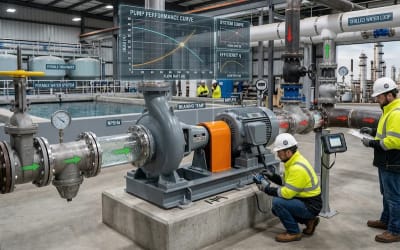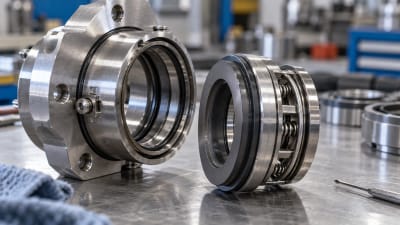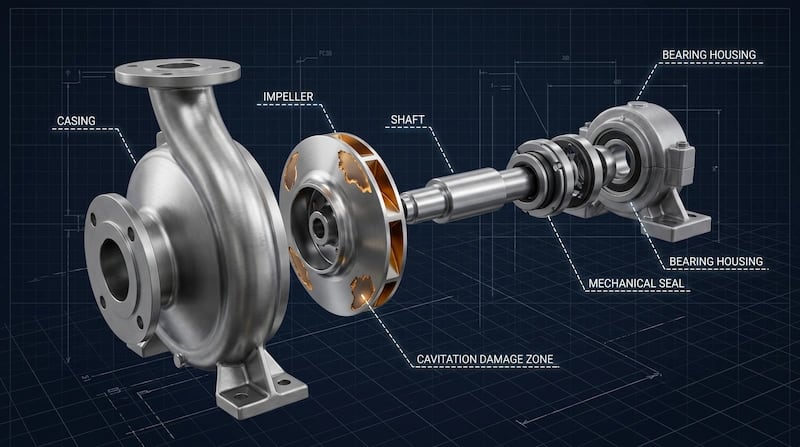
You walk out to the pump skid. The flow meter reads normal. The pressure gauge looks acceptable. Motor isn't tripping. And yet — there it is. That unmistakable gravelly rattle, like a handful of marbles tumbling inside the casing. Your operators say it comes and goes. Maintenance replaced the impeller six months ago, and it's already showing pitting again.
Your pump is cavitating. And the real problem is that it started long before anyone noticed the noise.
What Cavitation Actually Is — And Where the Textbook Misleads You
Cavitation is a phase-change event. When local static pressure at the impeller inlet drops below the vapour pressure of the liquid, the fluid flashes to vapour and forms tiny bubbles. Those bubbles travel into higher-pressure zones inside the impeller and collapse violently. Each implosion generates localised microjet pressures exceeding 1,000 MPa transiently. Microscopic individually, catastrophic cumulatively.
Here is where most engineers get misled: the NPSHR printed on your pump curve does not represent the start of cavitation. It represents the point where enough cavitation has already occurred to drop the pump head by 3%. Cavitation is actively happening well before you reach that number.
Field data and Hydraulic Institute research consistently show cavitation can begin at NPSHA values two to twenty times the published NPSHR. That stainless steel impeller that lasted three months? It was almost certainly cavitating from day one.
Four Cavitation Patterns You Actually See in the Field
Not all cavitation looks or sounds the same. Diagnosis requires distinguishing between modes.
Classic Suction Cavitation — Insufficient NPSHA relative to NPSHR. Bubbles form at the impeller eye and implode on the suction face of the vane leading edge. Damage appears on the underside of the vane — visible only with a mirror or borescope on a pulled impeller.
Suction Recirculation Cavitation — This one surprises engineers most often. It happens at low flow, well below Best Efficiency Point (BEP), when internal recirculation creates localised low-pressure vortices at the impeller eye — even when NPSHA is perfectly adequate by calculation. Damage appears on the pressure face of the vane, the opposite side from classic cavitation. If your calculations say NPSH is fine, but the impeller is pitting, look here first. Suction recirculation typically begins below 60–80% of BEP flow.
Discharge Recirculation Cavitation — Similar to suction recirculation but at the impeller outlet. Occurs under very low-flow operation and produces strong, low-frequency pressure pulsations that shake the entire casing and discharge piping violently.
Air Ingestion (Pseudo-Cavitation) — Not true cavitation, but symptoms are nearly identical. Air enters through leaking suction joints, a vortexing sump surface, or an inadequate submergence depth. Particularly common on sump-mounted end-suction pumps and after maintenance when fittings aren't properly re-torqued.
Why Your Pump Cavitates Even When the Screen Says ‘Normal'
This catches experienced engineers all the time. The SCADA trend looks perfectly boring, everyone is happy, and the pump is quietly chewing its impeller to pieces. Here's why:
1. You're running below BEP and nobody is watching the recirculation threshold. The throttle valve is partially closed, flow reads within a "normal" range, and no one has mapped where recirculation actually starts for that impeller. If you insist on running at 30–40% of BEP all day, no alloy will save that impeller for long.
2. Liquid temperature creeps up with the season. Water at 60°C sits around 20 kPa vapour pressure; at 80°C, it’s closer to 47 kPa – more than double. I’ve seen cooling‑tower return pumps that were fine in winter start rattling every summer because the process ran just 10–15°C hotter than the design sheet. NPSHA didn’t ‘look’ wrong on paper, but it was gone in reality.
3. The suction strainer is partially blocked. Even a 30–40% blockage creates enough pressure drop to reduce NPSHA below the critical threshold at high-flow operating points. Many plants have no differential pressure indicator across their suction strainers — so this goes undetected for months.
4. The system curve has changed. A process expansion, additional parallel flow paths, or removed resistance has shifted the operating point right on the pump curve — toward higher flow, higher NPSHR, and potentially insufficient NPSH margin.
5. Suction piping geometry is creating localised pressure drops. A 90-degree elbow directly at the suction nozzle. A reducer is installed backwards. Fewer than 5 pipe diameters of straight run before the suction nozzle. These effects create localised low-pressure zones that trigger cavitation even when the calculated average NPSHA appears adequate.
How to Detect Cavitation Before the Impeller Is Gone
Listen — but know what you're hearing. Cavitation produces a crackling, gravelly rattle inside the casing. Classic suction cavitation sounds like a steady, higher-frequency hiss. Suction recirculation produces a harsher, more intermittent rumbling with strong low-frequency vibration. Air ingestion sounds more random and bubbly, sometimes with gulping characteristics. Don't confuse these with bearing noise (higher-pitched, localised to the bearing housing) or mechanical rubbing (scraping sound tied rhythmically to shaft RPM).
Monitor vibration at the right frequency. Collapsing vapour bubbles generate broadband high-frequency energy, typically in the 1–10 kHz range. Standard low-frequency vibration monitoring misses this entirely. Ultrasonic accelerometers capable of detecting 20–100+ kHz can identify cavitation signatures before they become audible. For critical pumps, continuous high-frequency spectrum monitoring is the gold standard for early warning.
Track performance over time. A pump under chronic cavitation shows gradual performance loss: shortfall in flow at constant differential pressure, rising power consumption without matching flow gain, unstable discharge pressure at steady-state conditions. Plotting actual operating points against the pump curve every 6–12 months exposes degradation trends before failures occur.
Read the impeller damage pattern. When the pump is opened, the impeller confirms the mode. Pitting on the suction-face vane leading edge = classic suction cavitation. Pitting on the pressure face = suction recirculation. Erosion on vane outlet edges = discharge recirculation. Widespread shallow roughening = air ingestion. This pattern guides your root cause fix — not just your material replacement.
Prevention: Things That Actually Work in Real Plants
1. Maximise NPSHA at the design stage. Keep suction piping short and generously sized — suction line velocity should generally stay below 1.5 m/s. Minimise fittings, elbows, and valves in the suction run. Install differential pressure monitoring across suction strainers so blockage never silently erodes your NPSH margin. Use eccentric reducers flat-side-up on horizontal suction lines to prevent air pocketing.
2. Operate near BEP. The Hydraulic Institute defines the Preferred Operating Region (POR) as 70–120% of BEP. Within this range, internal flow is orderly, efficiency is near peak, and NPSH margin requirements are lowest. Outside it — especially below 60% — reliability drops sharply. On a 2.5 MW boiler‑feed pump, dropping speed by just 8–10% on hot summer afternoons was enough to calm the cavitation and extend impeller life from one outage cycle to three.
3. Maintain real NPSH margin — not just compliance. Treating NPSHR as a ‘safe’ operating point is one of the most expensive bad habits in our industry. By the time you’re at NPSHA/NPSHR = 1.0, you’re already cavitating – you’ve just decided to pretend you aren’t. ANSI/HI 9.6.1-2024 directs engineers to evaluate NPSH margin based on liquid characteristics, pump condition, and system influences.
For standard industrial process pumps: target an NPSHA/NPSHR ratio of at least 1.3–1.5. For high-suction-energy machines — large double-suction pumps, high-speed process pumps, liquids near the boiling point — a ratio of 2.0 or higher is justified. Field reliability data shows that doubling this ratio from 1.0 to 2.0 can approximately double pump mean time between failures.
4. Fix suction piping problems systematically. When cavitation is confirmed, but NPSHA calculations appear adequate, go to the piping. Add straightening vanes to eliminate inlet flow swirl. Increase the suction pipe diameter to cut velocity and friction losses. Relocate elbows at least 5–10 pipe diameters away from the suction nozzle.
5. Select cavitation-resistant materials for high-risk services. When some level of cavitation is unavoidable, material selection is your last line of defence. Cast iron and bronze are most vulnerable. 304/316 stainless steel offers significantly better resistance. Duplex stainless steels and nickel-aluminium bronze are appropriate for severe service. Material upgrades extend life — but they address consequences, not causes.
A Practical 7‑Step Check Before You Blame the Pump
When cavitation is suspected, work this sequence before pulling the pump:
- Make sure it really is cavitation — Stand next to the casing and listen for the gravelly rattle; check high‑frequency vibration if you have the sensors, and run your hand and a bit of soapy water around suction joints to rule out air being sucked in.
- Recalculate NPSHA with current conditions — use actual liquid temperature, actual strainer differential pressure, and current pipe condition. Not the original design calculation.
- Check where you are on the pump curve — what percentage of BEP? Are you in the POR or outside it?
- Inspect and pressure-test the suction strainer — confirm all suction valves are fully open.
- Verify current liquid temperature and vapour pressure — recalculate if the process has changed seasonally or operationally.
- If on a VFD, reduce speed 10–15% — this cuts NPSHR by 20–30%. If symptoms reduce, NPSH margin was the direct cause.
- Inspect the impeller last — the damage pattern confirms the mode and guides the fix. Replacing it without solving the root cause guarantees recurrence.
The Bottom Line
Treat cavitation as a system problem, not a pump problem. Every time you just swap an impeller or seal without fixing NPSH margin, operating point, or suction piping, you’re treating the symptom and keeping the disease.
Cavitation rarely announces itself with a big bang. It chips away at impellers, bearings, and seals in small increments — shifting costs slowly enough that no single event triggers an investigation. The engineers who catch it early understand one thing clearly: an NPSHA/NPSHR ratio of 1.0 is not a safe number. It's the edge of a cliff.