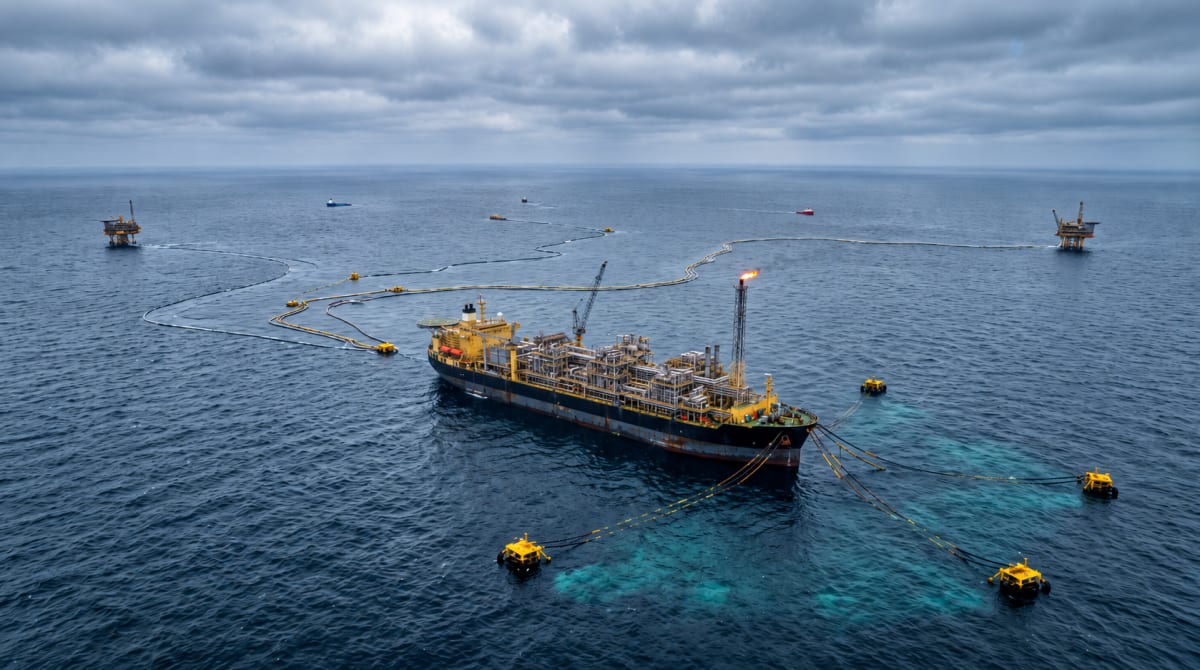
Aker BP began production from the Skarv Satellites on 26 August, bringing the Alve Nord, Idun Nord and Orn fields onstream in the Norwegian Sea roughly a year ahead of the original schedule. The three developments together hold close to 120 million barrels of oil equivalent in recoverable resources. Each uses a subsea template with two wells, tied back to the existing Skarv FPSO. Aker BP puts the carbon dioxide intensity of the production at around 4.5 kg per barrel.
The number worth sitting with is 4.5 kg/bbl
That figure is low not because of anything exotic in the wells, but because no new host was built. The Skarv FPSO already existed, with its separation train, its power generation and its export pumps already installed and already turning. Three fields arrived without a single new gas turbine.
That is the economic logic of a tieback. It is also the engineering constraint. A tieback brings no new topside capacity with it — it brings new fluid to equipment that was sized for a different field. The separation train now sees a different gas-oil ratio, a different water cut, and a different arrival pressure. Pumps selected against the original Skarv profile are asked to sit somewhere else on their curves.
Three questions worth asking on any tieback
Where does the duty point move? Commingled production from three satellites shifts both flow and suction pressure at the host. A pump that was efficient at its design point may now run out toward runout, or back toward shutoff, with the recirculation, vibration and radial loading that come with either.
When does subsea boosting become necessary? Reservoir pressure at the satellites will decline, and arrival pressure at the FPSO declines with it. Tiebacks of this kind eventually reach a point where the wells cannot deliver into the host system unaided, and seabed multiphase boosting becomes the route to extending plateau. Designing the retrofit path early is far cheaper than reacting to it later.
What does a cold flowline do to flow assurance? Long subsea tiebacks run cold. Hydrate and wax management, chemical injection rates and the injection pumps that deliver those chemicals all scale with tieback length rather than with production rate — which is why chemical injection skids on satellite developments are so often the first thing found undersized.
None of this is a criticism of the project. Bringing 120 MMboe onstream a year early through existing infrastructure is a strong result. It is a reminder that on a tieback, the interesting rotating-equipment problems live at the host, not at the wellhead.