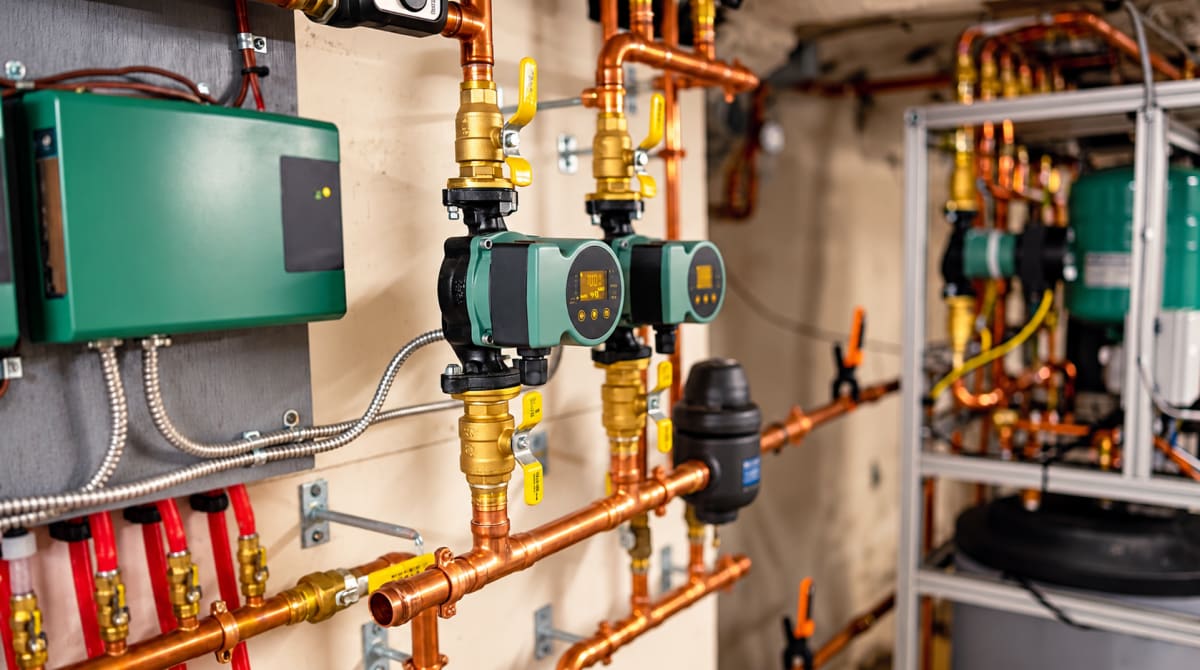
Taco has expanded its manufacturing of electronically commutated motor circulators, the small pumps that move water around heating and hot-water systems in buildings. ECM circulators have been displacing traditional fixed-speed units across both new installations and replacements.
Where the saving actually comes from
ECM circulators are usually sold on motor efficiency, and the motor genuinely is more efficient: a permanent-magnet rotor driven by electronic commutation avoids the slip losses inherent in a small induction motor, and small motors are where induction efficiency is worst.
But that is the smaller half of the story. The larger saving is that the pump stops running flat out when nothing needs it to.
A traditional circulator has one speed. It delivers its full flow whenever it is energised, regardless of how much heat the building is actually calling for. On a mild day with most zone valves closed, it is pushing against a nearly closed system and burning power to achieve almost nothing — while generating noise and valve wear in the process.
An ECM circulator with proportional-pressure control senses the system and slows down. Because a circulator in a closed loop is almost pure friction head with no static lift, the affinity relationship holds well: halving the flow drops the power draw toward an eighth. Over a heating season where the design condition occurs for a handful of days a year, that is where the annual figure comes from.
Two practical notes
Set the control mode deliberately. An ECM circulator left in fixed-speed mode is an expensive fixed-speed circulator. The commissioning step of selecting proportional or constant pressure, and setting the curve to the system, is what buys the saving — and it is skipped often enough to be worth naming.
Check the minimum flow through the heat source. Boilers and heat pumps frequently specify a minimum flow rate to avoid short-cycling or heat-exchanger stress. A circulator that throttles itself down intelligently can drop below it. A bypass or a low-loss header handles this, but it needs to be designed in rather than discovered.
Circulators are the least glamorous pumps in any building and among the most numerous. The efficiency case for them is unusually strong precisely because they run so many hours at so little useful load.