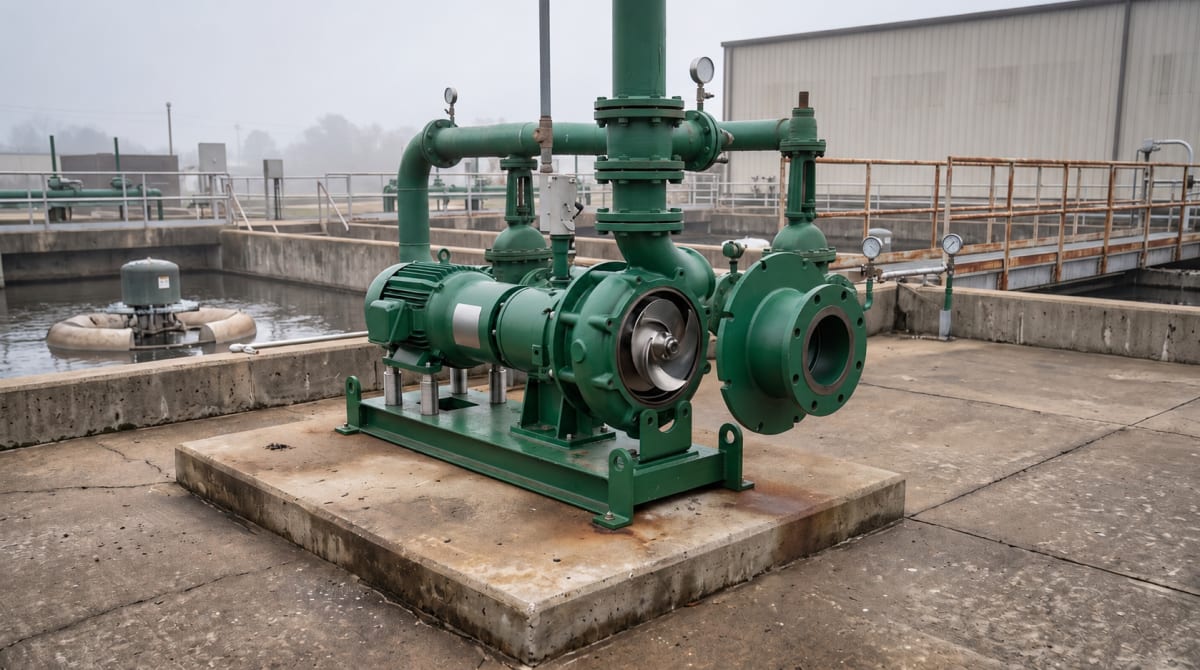
A chopper pump redesign has been shaped by direct feedback from operators rather than by laboratory development alone, with changes concentrated on the cutting geometry and on how quickly the pump can be opened and serviced in the field.
Why wastewater pumping got harder
The duty these machines face has changed materially over the past decade, and not because anyone designed it to.
Wet wipes are the reason most often cited, and the mechanism is specific: unlike paper, they retain tensile strength when saturated. They do not disintegrate in transit. Instead they combine with congealed fats and oils to form ropes that wrap around an impeller and accumulate at the leading edge until the passage is blocked.
A conventional solids-handling pump is the wrong answer to this. That design copes with solids by providing a large enough passage for them to travel through intact. It works for the debris it was conceived for. It does nothing about a material that is flexible, strong and inclined to wrap rather than pass.
What a chopper pump does differently
A chopper pump attacks the material rather than accommodating it. Hardened cutting edges on the impeller work against a stationary cutter plate, reducing solids before they reach the pump passages. The pump is a cutting machine with a hydraulic function attached.
That makes clearance the governing parameter. Cutting performance depends on the gap between the rotating and stationary cutters, and that gap opens as both wear. A chopper pump with worn cutters does not fail outright — it quietly reverts to behaving like a solids-handling pump, and then blocks. Many installations only discover the clearance has drifted after the ragging starts.
The point about operator feedback
This is the part worth taking seriously beyond this product. A pump like this is validated against test rigs using standardised rag simulants. Real pump stations receive whatever the catchment sends them, which varies by neighbourhood, by season and by what is currently being marketed as flushable.
Designing from field reports means designing against the actual distribution of problems rather than the assumed one. For anyone maintaining these stations, the transferable lesson is that cutter clearance belongs on a scheduled inspection, not on a fault report.