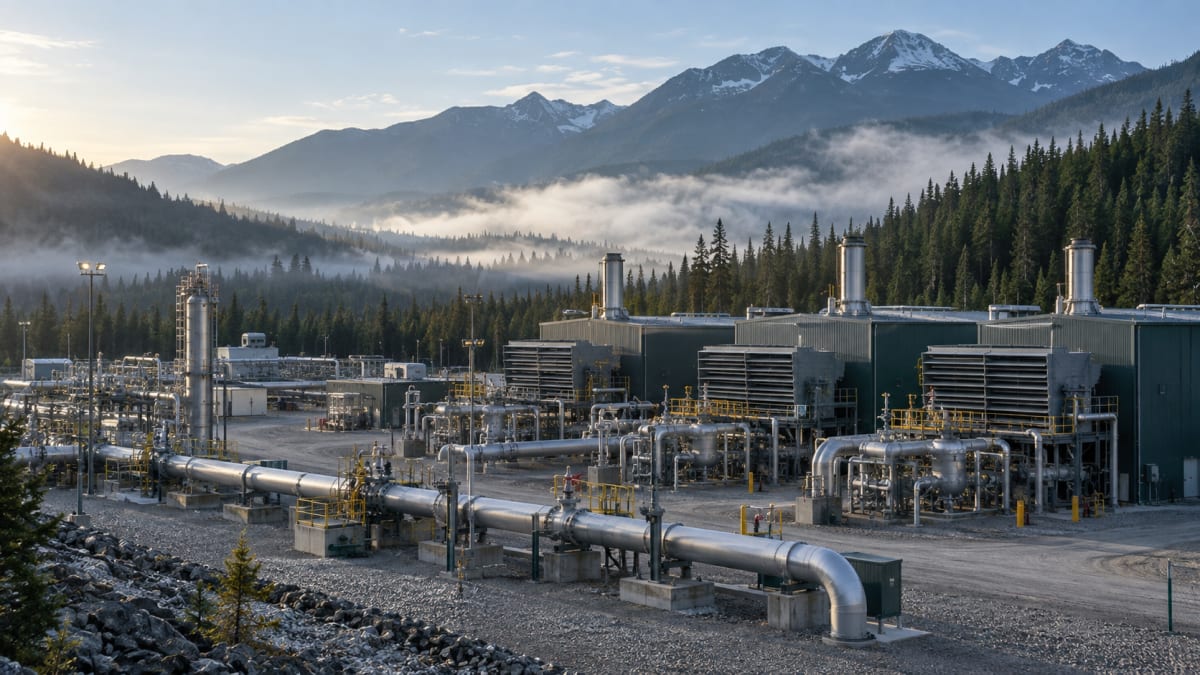
Enbridge and KKR, alongside funds managed by Apollo, have formed a joint venture to fund expansion of the Westcoast natural gas pipeline system in British Columbia, an investment of roughly US$1.95 billion. It covers two already-sanctioned programmes: Aspen Point, expanding the northern section and adding 535 MMcf/d, in service during 2026; and Sunrise, adding 300 MMcf/d, in service late 2028. Both hold regulatory approval and are underpinned by long-term take-or-pay contracts. Westcoast's total capacity rises to 3.9 Bcf/d.
There are only two ways to move more gas through an existing corridor
You lay more pipe alongside the existing line, called looping, or you raise the pressure by adding compression. Usually it is some of both, weighted by terrain, permitting and how much spare pressure the existing pipe can legally carry.
On a route through northern British Columbia, that balance tilts hard toward compression. New pipe means new right-of-way through difficult, environmentally sensitive and often contested ground. Compression means building within stations that already exist and already have access roads, power and permits. 835 MMcf/d of added capacity across two programmes is, in engineering terms, largely a compressor procurement.
Three consequences
Driver choice is now a carbon decision as much as an engineering one. Gas-turbine drivers are the traditional answer, since fuel is on site and no grid connection is needed. Electric motor drives shift emissions to the grid, which in British Columbia is overwhelmingly hydroelectric, but require substantial transmission infrastructure to remote stations. That trade-off, not compressor selection itself, is often the long pole in Canadian pipeline projects.
Take-or-pay contracts turn availability into a contractual term. Shippers have committed to pay whether or not they ship, and in return they expect the capacity to be there. An unplanned compressor outage stops being an operations problem and becomes a commercial one, which is why machines on contracted expansions are typically specified with spare capacity, redundancy and continuous condition monitoring that a merchant line might not justify.
A 2028 in-service date is a lead-time statement. Large compression trains are not catalogue items. Ordering, manufacturing, testing and installing them is measured in years, which is precisely why Sunrise sits two years behind Aspen Point despite being sanctioned alongside it.
The financing structure is worth a note too. Enbridge is bringing in outside capital rather than funding this from its own balance sheet, a pattern increasingly common in North American midstream. For readers who work on this equipment, the useful signal is simpler: firm contracts and regulatory approval mean these machines are genuinely being ordered, not merely announced.