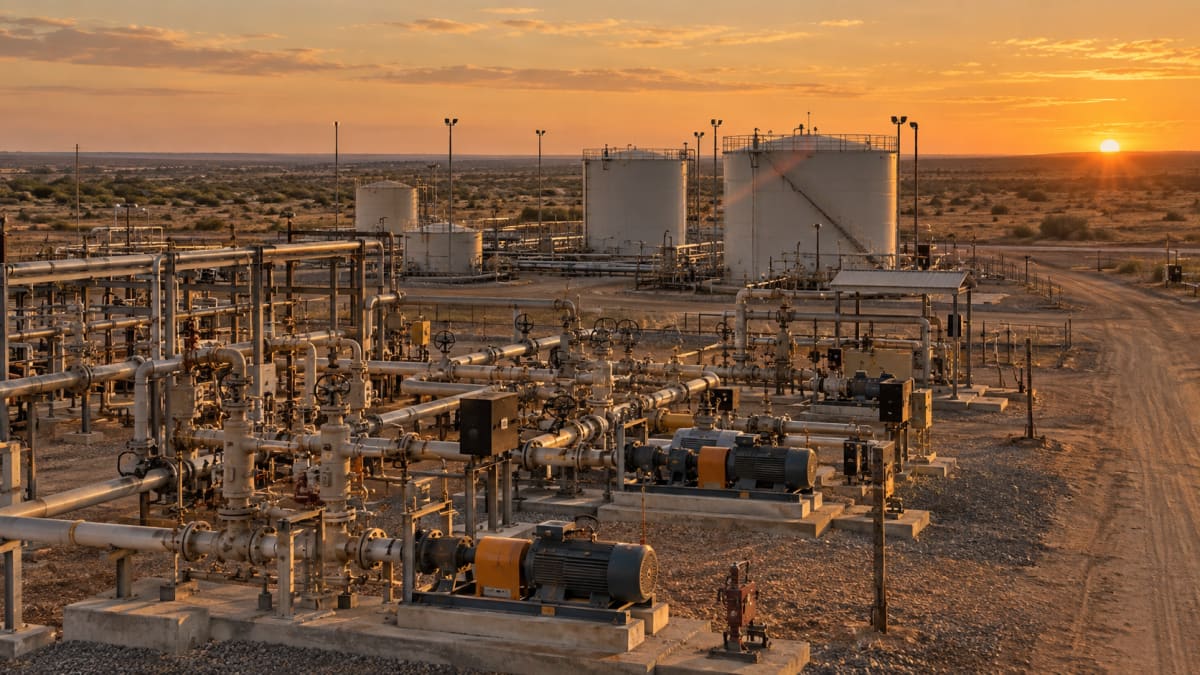
Enbridge has agreed to buy Salt Creek Midstream's crude oil gathering business for US$600 million in cash. The deal brings full ownership of the Orla and Wink North gathering systems plus a 50% stake in Delaware Crossing — roughly 500 miles of gathering infrastructure in the Delaware Basin, with throughput capacity up to 420,000 b/d and 350,000 bbl of storage. The systems serve more than 20 producers under long-term agreements across about 320,000 net dedicated acres, averaging around ten years remaining. Enbridge expects to close later in 2026.
Gathering is not a small pipeline; it is a different problem
The strategic story is the connection to Ingleside, North America's largest crude export terminal — Permian barrels now travel Enbridge's steel from wellhead to ship. The engineering story is what those 500 miles actually have to do.
A long-haul pipeline is the easy case: one product, steady rate, pumps sitting near their design point for years. A gathering system is the opposite in every respect, and that shapes the equipment.
Flow is never steady. Gathering lines collect from wells whose rates decline steeply, Permian wells especially, where first-year decline is severe. New wells come on at high rate, existing ones fade. Total throughput wanders constantly, and pumps sized for a design rate spend much of their life somewhere else on the curve. Turndown capability matters more here than peak efficiency.
The crude is not one crude. Twenty-plus producers means twenty-plus specifications arriving at different points. Density, viscosity, water content and vapour pressure all vary, and each variation changes the head a pump must develop for the same volumetric rate. Where batches are kept separate, interface tracking and valve sequencing become their own discipline.
Capacity is not utilisation. 420,000 b/d is what the system can pass. What matters commercially is what it does pass, and the gap between the two is where the return sits — filling existing steel is far cheaper than laying more. That usually means adding pumping capacity at existing stations rather than building new ones, a very different capital profile.
And the contracts change the maintenance calculus. Ten-year dedications across 320,000 acres mean producers have committed their barrels. Availability stops being an operational preference and becomes a commercial obligation, which pushes operators toward redundancy, condition monitoring and held spares rather than run-to-failure.