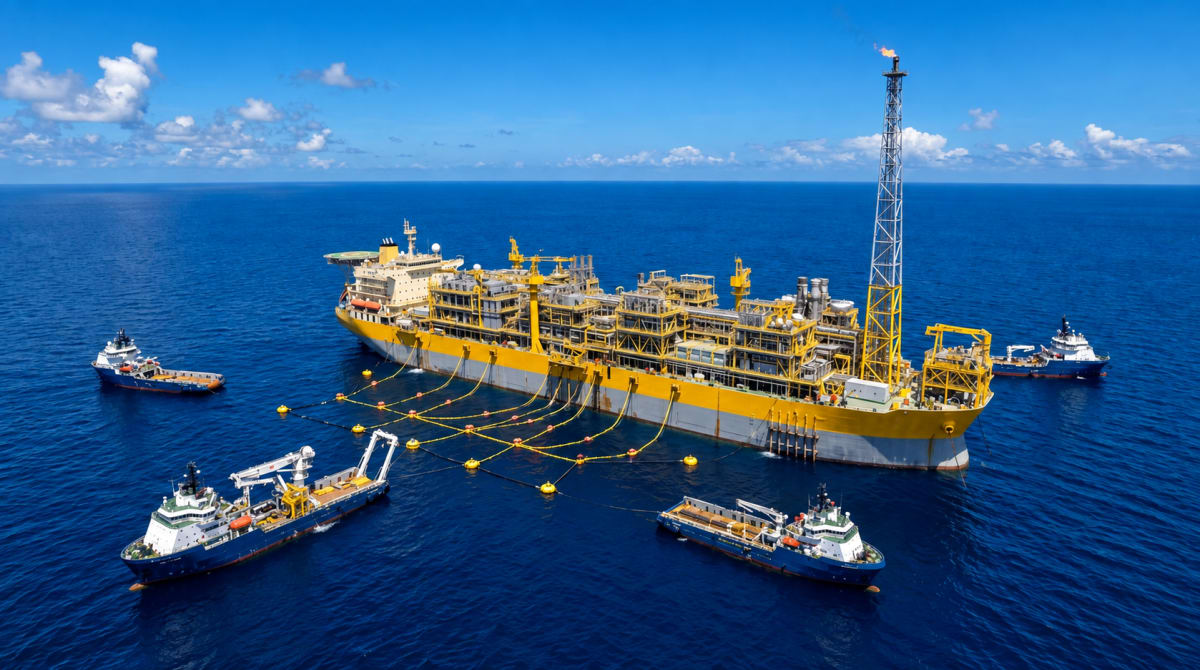
The Errea Wittu FPSO has arrived offshore Guyana for ExxonMobil's Uaru development, the fifth production vessel in the Stabroek block and the largest in the country's fleet. Built by MODEC, the unit is designed for 250,000 b/d of oil, 540 MMcfd of gas treatment capacity and roughly 2 million bbl of crude storage. It will be spread-moored about 200 km offshore in 1,690 m of water. The name means abundance in the Warrau language.
Read the specification as a pumping problem
The headline number is 250,000 b/d of oil. But across the life of a deepwater development like this one, the volume of water handled routinely exceeds the volume of oil produced, often by a wide margin in later years as water cut climbs and pressure support demands rise. The rotating equipment that defines the vessel's later life is therefore not the oil train. It is the water train.
Injection pumps set the ceiling. Pressure support in a deepwater reservoir means high-rate, high-head water injection, and the discharge pressure required scales with depth and reservoir conditions. These are among the largest and highest-energy machines on the vessel. Their availability, more than almost anything else, governs whether plateau is held or lost.
Produced water handling is a treatment problem before it is a pumping one. Hydrocyclones, degassers and transfer pumps have to deliver water clean enough to inject without fouling the formation, and clean enough to discharge within limits when it is not reinjected. Solids and residual oil damage both the wells and the pumps.
Storage capacity sets an offloading rhythm. Two million barrels of storage against 250,000 b/d means the vessel fills in roughly eight days at full rate. Every one of those cycles ends in an offload to a shuttle tanker, and cargo pump capacity determines how long that takes. Offloading pumps that fall behind do not reduce efficiency — they stop production, because there is nowhere to put the oil.
And 540 MMcfd of gas treatment implies compression, not flaring. Gas at that scale on a Guyana development goes back into the reservoir, and reinjection compression is a substantial power consumer and maintenance load in its own right.
Spread mooring rather than a turret is a sensible choice at this size in these conditions. It also fixes the heading, which means riser geometry and the arrival conditions the topside equipment sees are set at design and not adjustable later.